Supporting mothers and communities for safer births in Nepal
May 26, 2026
Please note that the names of individuals and health care facilities featured in this story have been changed for privacy.
Chahana Yadav loads her navy backpack with notebooks, writing utensils, and richly illustrated pamphlets before setting out on foot. Chahana will deliver the materials in her pack to pregnant women in southern Nepal’s Madhesh Province. Throughout the region, more than 25,000 soon-to-be mothers have learned about prenatal health, nutrition, warning signs of complications, and how to care for themselves and their babies before and after birth. Chahana is a Sub-District Officer, and her goal is to raise awareness about maternal and newborn health however she can.
“We contact pregnant women through phone calls and also visit their homes for follow up,” she explains. “If we are to spread awareness, we should do it in every possible way.”
Chahana’s work is part of the Maternal and Newborn Health (MNH) Continuum of Care project, led by Population Services International/Nepal (PSI/Nepal). Started to support expectant mothers, their family members, and health institutions, the MNH project has supported women to access health information and make decisions about their care before, during, and after birth. The MNH project includes Pregnant Women Groups, as well as meetings for husbands and mother-in-laws — all of whom are traditionally involved in making birthing decisions in Nepal.
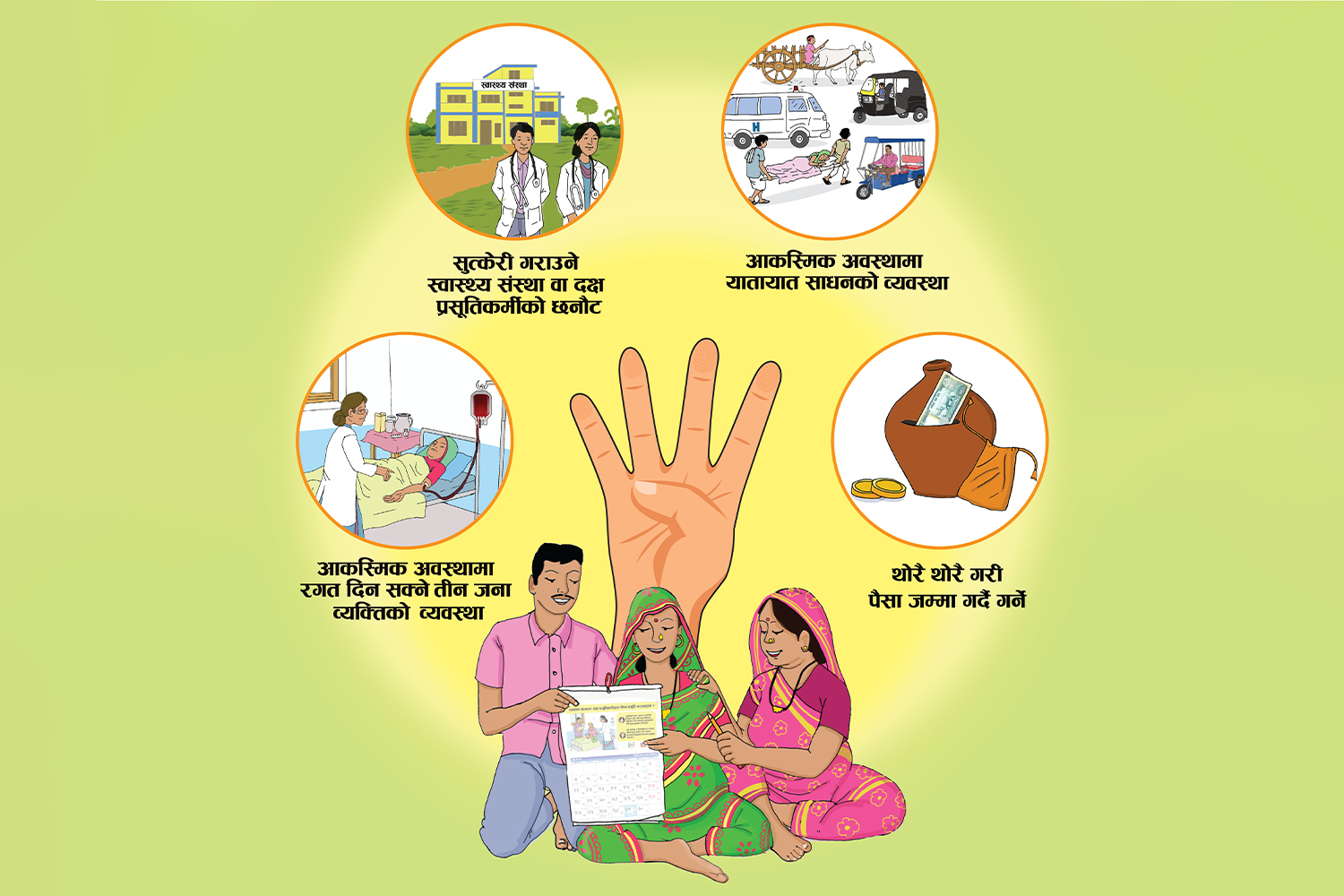
Continuum of Care materials use easy-to-understand illustrations to communicate important information. This illustration depicts the four key preparedness recommendations during pregnancy. The preparedness recommendations include management of blood/blood donors, selection of skilled birth attendants and health facilities, management for emergency transportation, and financial management. Illustration provided Population Services International/Nepal.
Creating community for women and families
Indira Janakpur lives in Siraha, a cultural hub with a population just under 100,000. The mother-to-be is part of a Pregnant Women Group, where dozens of expectant mothers meet monthly to learn, share knowledge, and build confidence together. The groups are led by Sub-District Officers like Chahana, or Female Community Health Volunteers. Indira has experienced pregnancy loss, a common outcome that can be both physically painful and emotionally devastating.
Mothers-to-be like Indira, who want to learn more about prenatal and postnatal care, are central to the MNH program. Information is presented in person, and illustrated materials are available for women to bring home. For those who do not read, the illustrations provide detailed reminders of what they learn together in groups.
Fathers and extended family members are also an important part of health care decisions, and they are not forgotten in the MNH project.
“When we attended this program, we were able to get information on having a safe delivery, healthy foods, and when to go for a checkup,” said Sandesh Chaudhary, whose wife attends a Pregnant Women Group. “The people in the community have learned a lot from this program.”
Fathers-to-be like Sandesh also have an opportunity to meet and ask questions specific to fathers. They learn about how to manage finances, plan for transport to health institutions, and how to physically care for new mothers and babies. According to a PSI study, the percentage of families managing money for transportation increased from 27% to 66% after participating in the MNH project, and nearly three quarters of participants had arranged transportation after attending meetings — a 73% increase that means more mothers giving birth in health institutions.
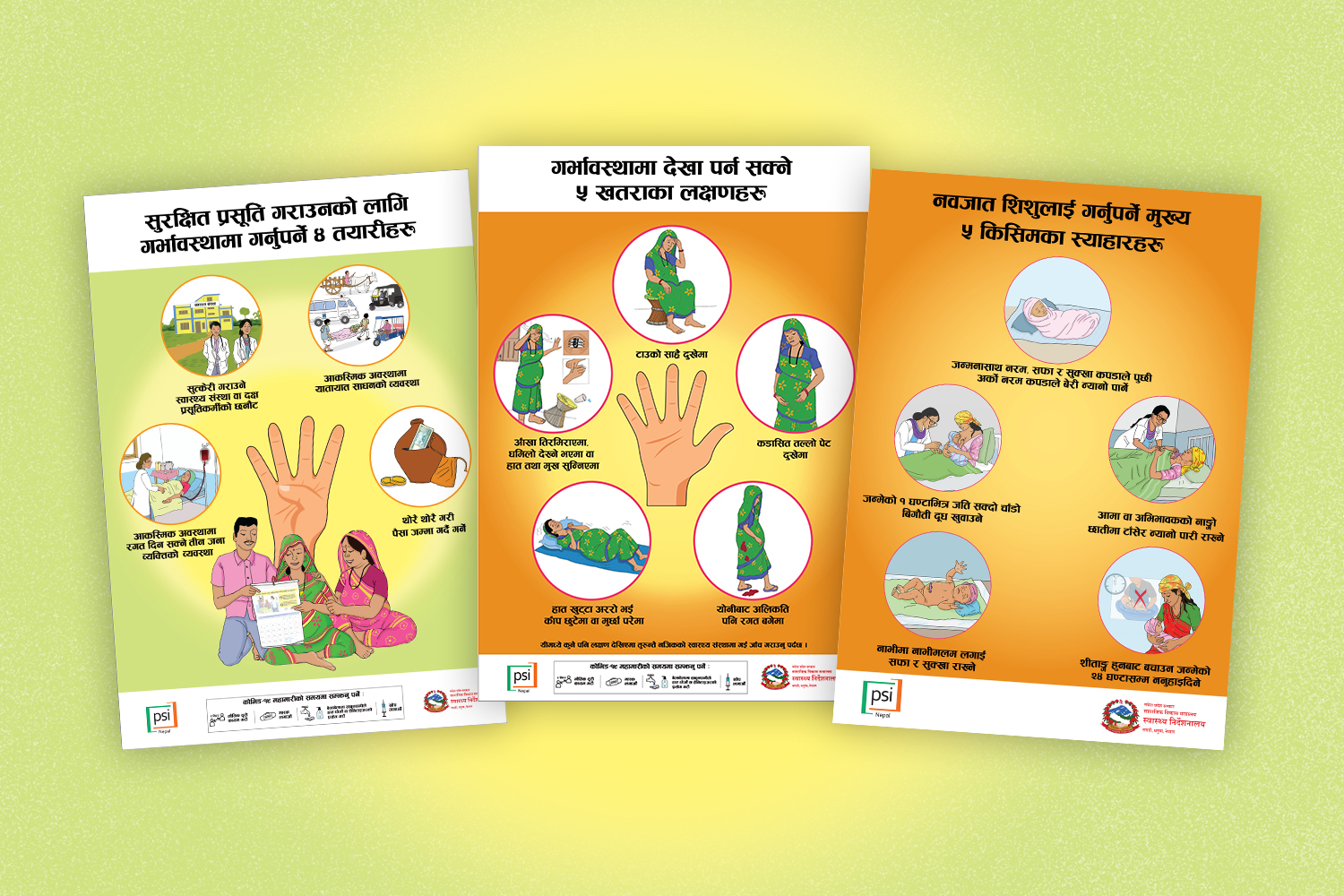
These Continuum of Care posters were developed to help communicate information on birth preparedness, pregnancy danger signs, and essential newborn care. Materials provided by Population Services International/Nepal.
Training and mentorship for health care workers
Additional reasons for the increase in institutional births include higher-quality medical equipment and more robust care for patients. The capacity-building efforts of the MNH project have helped reduce both maternal and infant mortality by equipping 143 health institutions — including 23 birthing centers — with equipment like wheelchairs, baby warmers, and autoclaves to sterilize equipment and prevent infection. Health Facility A recently recorded 281 deliveries, up from 71 deliveries during its early years of operation, a sign of increased trust in the quality of services.
Additional training and hands-on learning opportunities for health care workers have also helped increase confidence in delivery of care and widened the knowledge-base of staff.
“We learned how to conduct normal deliveries, counsel clients, manage abnormal deliveries, and identify critical cases,” said Skilled Birth Attendant Sarswati Rai. She works at a health care facility that has also started offering post-natal care home visits. Sarswati feels that both her theoretical and practical knowledge have increased, especially when managing complications like breech deliveries and emergencies like eclampsia.
To date, hundreds of staff received additional training in infection prevention and took part in mentorship opportunities. As quality of care has improved, expectant mothers have taken notice. The number of pregnant women visiting health care institutions before, during, and after birth has significantly increased.
“As a result of our efforts, the number of pregnant women coming in for antenatal (prenatal) care visits has increased, institutional deliveries have also increased, and the number of post-natal care visits has also increased at health institutions,” said Aurahi Municipality Health Coordinator Ramesh Prasad Gupta. The data, while preliminary, show an upward trend toward expectant mothers — and their family members — proactively opting and planning for safer deliveries.
Communities transformed
The MNH project has been supported by a grant from the Maternal and Child Health program of Margaret A. Cargill Philanthropies (MACP), which aims to equitably improve survival and well-being for women, adolescents, and children. For expectant mothers like Indira Janakpur, being part of the MNH project through a Pregnant Women Group has been transformative.
“I have learned what to do and what not to do to be safe during pregnancy,” said Indira, who no longer fears pregnancy loss. “I will also learn more from the sister (Sub-District Officer), and other pregnant mothers will learn from her as well. Now I can advise other pregnant women on what they should and shouldn’t do. We should not be afraid of anything.”
For the communities involved in the MNH project, changes have developed quickly. Saptakoshi Municipality’s mayor, Naresh Kumar Mandal, has seen communities learning from one another throughout Madhesh Province. And, as the project comes to an end, he anticipates even greater connections and access for women and their babies.
“The communities,” he said, “have been transformed.”

Author: Alauna Yust
An Emmy award-winning multimedia producer, writer, and filmmaker based in the Twin Cities. In 2018, she founded Rookwood Media, a video production company that tells stories leading to a kinder, greener, more equitable world. Her work has been distributed nationally by PBS, The Moth Radio Hour, Public Radio Exchange, and many other outlets.